

Updated on September 29, 2026
Yes, dense rugs and heavy curtains stop room echo without acoustic foam panels. They succeed when materials provide adequate physical thickness and cover the primary hard reflective surfaces where sound waves bounce. In 2026, treating domestic or commercial spaces for excessive noise relies on basic acoustic physics rather than wall-mounted studio products.
The 30-second brief:
- Sound waves striking hard surfaces either reflect back into the room, transmit through partitions, or absorb into porous fibrous materials.
- Heavy area rugs and runners muffle footstep impact and furniture movement better than hard wood, concrete, or tile floors.
- Acoustic absorption performance increases with material thickness, structural density, and open porosity across conversational frequencies.
Can Rugs and Curtains Stop Room Echo Without Foam?
Heavy textiles eliminate excessive reverberation by trapping airborne sound waves inside porous fiber structures without requiring dedicated studio foam. Sound waves bounce off hard, reflective surfaces and redirect back into the open space. If those waves bounce freely, reverberation builds up until ambient room tone is loud, making clear communication difficult.
Foam panels are merely one method to introduce porous absorption into an interior. Everyday furnishings made from dense woven fibers perform the exact same physical function while blending into standard architectural spaces.
How do rugs and curtains absorb sound waves?
When sound interacts with a material, the energy is reflected, transmitted, or absorbed. Hard drywall and glass boundaries reflect almost all incoming energy directly back into the room volume. Soft, fibrous textiles allow sound energy to penetrate their outer face.
Porous materials tend to have higher sound absorption due to their ability to trap sound within their open structures. As vibrating air molecules push through the tortuous pathways between individual strands of yarn, friction transforms acoustic energy into tiny amounts of heat, preventing the wave from re-entering the room as an echo.
Why soft furnishings are effective alternatives to foam
Standard open-cell foam panels often treat only higher treble frequencies because they lack substantial mass. Furnishings with significant structural density offer strong resistance to sound waves across a broader spectrum of speech frequencies.
Using floor coverings and wall drapery treats acoustic reflections at their point of origin. Instead of installing specialized industrial panels, furnishing a space with heavy textiles solves flutter echo while serving everyday functional needs.
How to Position Rugs and Curtains for Maximum Echo Reduction
Effective acoustic placement targets parallel reflective boundaries where sound waves bounce repeatedly across open living areas. Treating an echoey room does not require wall-to-wall textile coverage, but it does require interrupting direct reflection paths between flat, opposing planes.
Focusing on the largest bare surfaces yields immediate reductions in room tone and eliminates harsh ringing artifacts caused by speech or media playback.
Where should you place noise-dampening rugs?
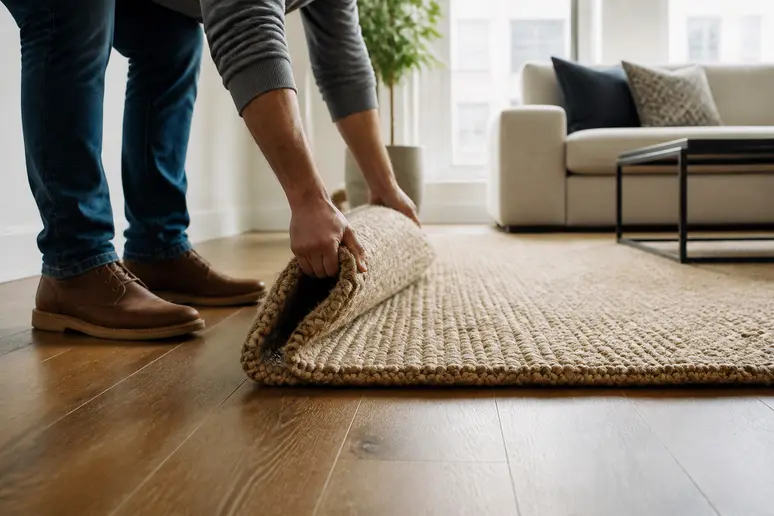
Carpeting or area rugs and runners muffle the sound of footsteps and shifting tables and chairs better than wood, concrete, or tile floors, absorbing sound waves rather than reflecting them. Uncovered hard floors reflect mechanical impact noise upward toward the ceiling, amplifying ambient room sound.
Place primary rugs directly beneath conversational seating groups and under dining sets where chair legs shift against hard surfaces. In long hallways or entry corridors, continuous runners break up the long travel paths of sound waves along narrow boundaries.
How to hang acoustical curtains over glass and bare walls
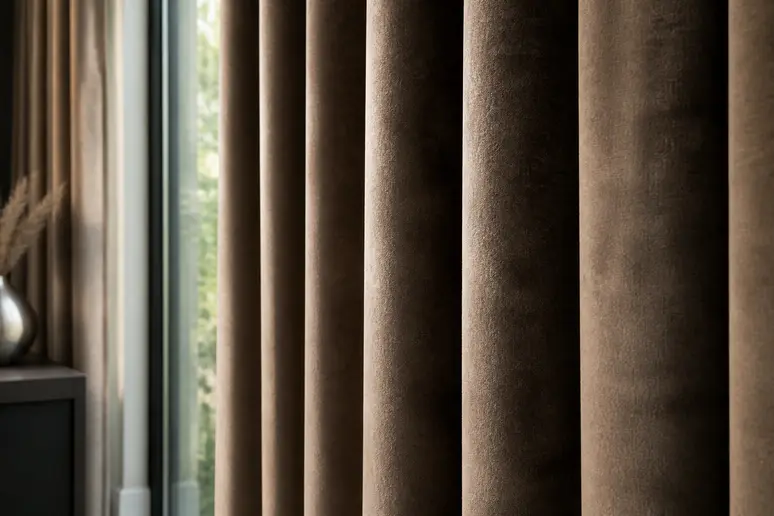
Acoustical curtains added to big windows and glass surfaces pull double duty by blocking summer sun and providing soft absorptive materials for echo control. Glass represents one of the most acoustically reflective materials in standard construction.
Hang curtains with significant fullness so that the fabric forms deep, continuous folds rather than hanging flat. The air cavity created between deep drapery pleats and the flat window surface increases low-frequency absorption and prevents sound from bouncing between parallel glass and drywall.
Matching Soft Furnishings to Specific Room Surface Issues
Use the following guide to identify the appropriate furnishing treatment based on the primary reflective surfaces present in your space.
| Surface Condition | Recommended Action | Acoustic Target |
|---|---|---|
| Bare hardwood, concrete, or tile flooring | Lay thick area rugs over dense felt underlayment pads | Muffles impact noise and stops vertical floor-to-ceiling bounce |
| Expansive glass windows or patio sliders | Install heavyweight pleated curtains extending past the window frame | Dampens sharp high-frequency reflections off smooth glass |
| Parallel bare drywall boundaries | Hang dense drapery panels or woven fabric wall hangings | Eliminates horizontal flutter echo across speech frequencies |
| Long narrow hallways with hard floors | Place continuous carpet runners along walking paths | Controls ambient reverberation buildup and footstep sound |
Rooms with very high ceilings may still experience persistent vertical reverberation that floor rugs and perimeter curtains cannot fully resolve on their own.
What Material Characteristics Matter Most for Sound Absorption?
Acoustic absorption efficiency depends on physical thickness, mass density, and surface porosity rather than decorative patterns. Thicker materials generally offer greater sound absorption across a broader frequency range, capturing lower frequencies that pass right through thin fabrics.
Choosing textiles purely for aesthetic reasons often fails to solve echo problems because lightweight materials lack the mass required to stop acoustic energy.
Why material thickness and density improve acoustic performance
ASTM International defines NRC as a single-number rating rounded to the nearest 0.05 based on frequencies at 250, 500, 1000, and 2000 Hz. Standardized testing demonstrates that higher-density materials also often exhibit better sound absorption across these specific bands.
Denser fabrics present greater physical mass to vibrating air particles, dissipating more kinetic energy through friction. When selecting window drapes or floor underlays, opt for dense, tightly packed weaves that resist compression.
How surface textures and deep piles trap sound energy
High-pile tufted rugs, looped wool, and thick velvet fabrics create textured surfaces that scatter incoming acoustic waves. Instead of reflecting cleanly off a flat surface, the sound penetrates deep into the pile where open structures absorb the energy.
Flat-woven mats and thin sheer curtains provide negligible sound dampening because their tight, thin structure acts almost like a solid reflective sheet. Plush, open-textured weaves ensure maximum surface contact for incoming sound energy.
The next question you will face is whether layering multiple thin fabrics matches the acoustic performance of one dense textile. It does not, because lightweight fabrics lack the physical density required to trap sound energy across lower frequencies.
Frequently Asked Questions
Do standard decorative curtains stop room echo?
Standard decorative curtains made from thin cotton or polyester provide minimal acoustic improvement because sound waves pass through the fabric and reflect off the window glass. Noticeable echo reduction requires thick, dense materials such as heavy velvet, wool, or lined thermal drapery.
Can an area rug reduce sound transmission through floors?
While rugs reduce impact noise within the room, blocking sound transmission between separate building units requires structural decoupling.
Why does room echo intensify when more people talk?
Reverberation accumulates when acoustic waves bounce freely off hard, reflective surfaces, raising the ambient background noise floor. People unconsciously raise their voices to be heard over this lingering noise, which injects more acoustic energy into the room and worsens the echo cycle.
What makes porous materials better at absorbing sound?
Porous materials have open structures that allow vibrating air particles to enter instead of bouncing off the surface. Friction between the moving air particles and the internal fiber network converts acoustic energy into heat, removing it from the room.
How does ASTM International measure sound absorption in materials?
This standardized test averages the material sound absorption coefficients across those four speech frequencies.
The information in this article is provided for guidance only. For any building work, consult a qualified professional who can assess your specific situation under the standards in force.
Sources
Pages consulted for this article: