

Updated on August 8, 2026
Trademarking a phrase for your business in 2026 starts with a base USPTO filing fee of $350 per class, but this figure can easily climb with additional charges for incomplete information, specific application types, or the need for professional legal assistance. Navigating the United States Patent and Trademark Office (USPTO) system requires precision to avoid unnecessary costs, emphasizing that upfront clarity saves money in the long run.
What Official Sources Disagree On: Understanding Trademark Fee Discrepancies
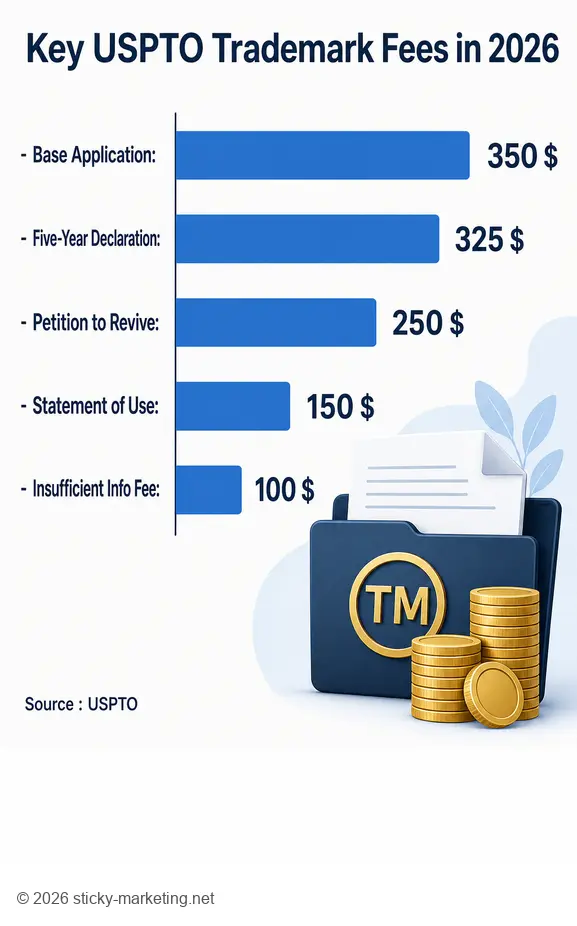
When researching trademark costs, businesses might encounter varying figures, which can be confusing. For instance, some reliable sources, referencing older schedules, suggested the five-year declaration fee (Section 8 or Section 71) was around $225 per class. However, the official USPTO website states this fee as $325 per class.
A similar discrepancy appears for the 10-year renewal fee combined with a five-year declaration. While some outlets cite an older combined fee of $525 per class, the USPTO’s official fee for this combined filing (Section 8 or Section 71 and Section 9) is $650 per class. always consult the official USPTO fee schedule directly for the most accurate and up-to-date pricing. Third-party sources, while often helpful, may not always reflect the latest government fee structures or specific application nuances.

What are the USPTO Filing Fees for Trademarking a Phrase in 2026?
Understanding the direct filing fees from the United States Patent and Trademark Office (USPTO) is the first step in budgeting for a phrase trademark. The USPTO updated its rules on January 18, 2025, consolidating to a single application system, simplifying the initial choice but maintaining a clear fee structure based on the specifics of your application. Factoring in these core costs avoids surprises.
Official USPTO Trademark Filing and Maintenance Fees (2026) according to the official USPTO website:
| Fee Type | Cost Per Class |
|---|---|
| Base application filing fee (Section 1 or Section 44) | $350 |
| Insufficient information fee | $100 |
| Free-form text identification fee (not from ID Manual) | $200 |
| Additional free-form text fee (per extra 1,000 characters) | $200 |
| Statement of Use or Amendment to Allege Use (intent-to-use) | $150 |
| Extension of time to file Statement of Use (intent-to-use) | $125 |
| Petition to revive abandoned application | $250 |
| Five-year declaration (Section 8 or 71) | $325 |
| Five-year declaration grace period fee | $100 |
| Combined Section 8 or 71 and Section 15 declaration | $575 |
| Combined Section 8 or 71 and Section 9 declaration (10-year renewal) | $650 |
| 10-year renewal grace period fee | $100 |
| Declaration of incontestability (Section 15) | $250 |
| Processing fee for refused or charged back payment | $50 |
What is the base application cost per class?
The base application cost is $350 per class in 2026. This fee applies to each class of goods or services your phrase will identify, for both Section 1 (use in commerce) and Section 44 (foreign application) filings, provided the application fulfills all requirements. If your phrase covers multiple distinct categories, you must pay this $350 fee for each class, adding directly to your total.
What are the additional fees for complex applications?
Beyond the base fee, additional costs can arise if your application is incomplete or uses non-standard descriptions. An insufficient information fee of $100 per class is charged if certain mandatory details are missing at the time of filing.
Furthermore, a $200 fee per class is imposed if you use free-form text for your goods and services identification, and those descriptions are not found within the USPTO’s Trademark Identification (ID) Manual. An extra $200 fee also applies for each group of 1,000 characters beyond the first 1,000 used in such free-form identifications, per affected class. These fees can quickly accumulate, pushing a $350 per class application to over $1,300 per class in some cases.
What fees apply to intent-to-use applications?
Intent-to-use (Section 1(b)) applications incur specific fees because you are registering a phrase before it is actively used in commerce. Once you begin using the trademark, you must file an Amendment to Allege Use or a Statement of Use, each costing $150 per class.
If your business isn’t ready to use the phrase within the initial timeframe, you might need to request an extension of time to file the Statement of Use, which costs an additional $125 per class for each extension. These fees are staggered over the registration process.
How Can You Optimize and Reduce Trademark Filing Costs?
Reducing trademark filing costs often comes down to meticulous preparation and adherence to USPTO guidelines. Businesses that take the time to understand the process upfront can avoid many of the additional fees that catch unprepared applicants off guard.
Utilizing the Trademark ID Manual to save on fees
One of the most effective ways to reduce filing costs is by using the USPTO Trademark ID Manual. This manual provides a pre-approved list of descriptions for goods and services. By selecting your descriptions directly from this manual whenever possible, you avoid the $200 fee per class imposed for free-form text identifications not found within it. This also helps prevent the additional $200 charge for lengthy free-form descriptions, keeping your application streamlined and cost-efficient.
Providing complete information at filing
The USPTO charges an insufficient information fee of $100 per class if required elements are not provided at the time of filing. To avoid this fee, your application must include all necessary details: your name, email, domicile, legal entity type, citizenship, filing basis, fees for each class, a signed declaration, digital image for stylized marks (if applicable), color claims, English translation (if applicable), transliteration, and US attorney information (if represented). Missing even one item can trigger this $100 fee per class, regardless of how many requirements are missing.
Budgeting for future costs
While an intent-to-use application allows you to reserve a phrase, it also introduces future costs. Budgeting for these means anticipating the $150 per class fee for the Statement of Use and any $125 per class extension requests. Consider the timeline for actual use and plan these subsequent filings into your financial projections. Proactive budgeting avoids unexpected expenses after your initial filing.
What Qualifies a Phrase for Trademark Protection?
Not every catchy phrase can be trademarked. The USPTO has specific criteria designed to ensure that trademarks serve their purpose: distinguishing the source of goods or services. Understanding these qualifications upfront avoids investing time and money in an application that is likely to be rejected.
The importance of distinctiveness and non-descriptiveness
For a phrase to qualify for trademark protection, it must be distinctive and not merely generic or descriptive of the goods or services it represents. A generic term, like “shoe store” for a business selling shoes, cannot be trademarked because it describes the product category directly.
Similarly, a merely descriptive phrase, such as “Fast Shipping” for a delivery service, would also be rejected as it simply describes a characteristic of the service. The phrase must uniquely identify your company in a way that doesn’t mislead the public, moving beyond simple description to become a source indicator.
Requirements for use in commerce
A phrase must be used, or intended for use, as an identifier of your company in the sale of goods or services. It needs to function as a brand name or slogan that consumers associate directly with your business. This means the phrase should appear on products, packaging, marketing materials, or in connection with the offering of services, signaling its role as a commercial identifier. Filing an “intent-to-use” application acknowledges this requirement, giving you time to implement the phrase commercially.
Common reasons for trademark application rejection
Trademark applications are commonly rejected for several reasons, primarily falling into two categories: the phrase is too descriptive or generic, or it is confusingly similar to an existing trademark. If your phrase is deemed to be merely descriptive of your goods or services, or if it is generic for your industry, the USPTO will refuse registration.
Furthermore, if your phrase so closely resembles another registered or pending trademark that it’s likely to confuse consumers about the source of the goods or services, your application will also be rejected. Thorough preliminary research mitigates these risks.

What are the Long-Term and Indirect Costs of Trademarking a Phrase?
True trademark costs extend far beyond the application, encompassing ongoing maintenance, potential legal assistance, and vigilance against infringement.
Understanding trademark maintenance and renewal fees
After your phrase is initially registered, you’ll need to submit maintenance filings at regular intervals to keep the mark active. A declaration of use (Section 8 or Section 71) is required between the fifth and sixth years following registration, costing $325 per class. If filed late, an additional $100 grace period fee per class applies.
A combined 10-year renewal (Section 9) and another declaration of use (Section 8 or Section 71) is due every ten years thereafter, costing $650 per class, also with a $100 grace period fee per class if submitted late. These fees are mandatory.
The cost of professional legal assistance
While you can file a trademark application yourself, seeking professional legal assistance is often a valuable step, especially given the complexities of distinctiveness and potential conflicts.
| Service | Estimated Cost |
|---|---|
| Attorney fees for trademark services | A few hundred to a few thousand dollars |
| Thorough trademark search | $300 to $1,000 |
This minimizes the risk of rejection or future litigation.
Potential costs for monitoring and enforcement
Trademarking a phrase isn’t just about protecting your own use; it’s also about preventing others from using something similar. Trademark monitoring services typically charge between $100 and $500 annually to alert businesses to potential infringements by new applicants or users. Should an opposition be filed against your application, or if you need to defend your mark against an infringer, legal costs can become significant. These expenses cover legal fees for negotiations, cease and desist letters, or even litigation, protecting the exclusive rights you’ve established.
What is the Timeline for Trademarking a Phrase?
The process of trademarking a phrase isn’t an overnight affair; it involves several distinct stages, each with its own duration. Understanding this timeline helps businesses set realistic expectations and plan for the effective launch or protection of their brand identifier. Delays can occur, so patience and preparedness are key.
Key stages of the application process
The typical trademark registration process starts with a preliminary search to identify potential conflicts. This is followed by preparing and filing the application through the Trademark Electronic Application System (TEAS). After filing, the application undergoes an examination period, which usually lasts between six to eight months, during which a USPTO examiner reviews your application for compliance with all legal requirements.
If approved, the phrase is published for opposition in the Official Gazette for 30 days, allowing third parties to object if they believe your mark infringes on theirs. If no opposition is filed, or if it’s resolved, the phrase moves to final registration.
How intent-to-use applications affect the timeline
Intent-to-use applications generally extend the overall timeline for trademark registration. After the examination and publication periods, if no issues arise, the USPTO issues a Notice of Allowance. However, the trademark is not registered until you file a Statement of Use, demonstrating that you have begun using the phrase in commerce.
You have six months to file this statement, with the option for up to five additional six-month extensions, potentially extending the process for up to 36 months after the Notice of Allowance. Each extension requires a fee, making these applications longer and potentially more costly.
Cet article est fourni à titre informatif. Les règles et législations évoluent régulièrement : vérifiez toujours les conditions en vigueur auprès des organismes officiels ou d’un conseiller spécialisé.
FAQ
How long does it take to trademark a phrase?
The typical timeline for trademarking a phrase can range from approximately 12 to 18 months for standard applications. However, intent-to-use applications can take significantly longer, potentially up to 36 months after a Notice of Allowance, due to the need for additional filings to prove use in commerce.
What happens if I miss a trademark renewal deadline?
Missing a trademark renewal deadline can result in additional grace period fees of $100 per class for both five-year declarations and 10-year renewals. If the grace period is also missed, the trademark may be canceled, requiring you to file a new application and potentially lose your priority rights to the phrase.
Sources
Information verified from the following sources: